 Български
 English
The GOALS OF SPATIAL PLANNING in Bulgaria until 2030

The planned perspective until 2030: "Achieving a balanced spatial development, based on the local potential and convergence of the regions in a territorial, economic and social aspect".
The goals of Spatial Planning in Bulgaria until 2030 are:
- Spatial integrity and equal accessibility of public service systems (with an emphasis on education, health care, culture and sports);
- Preserved natural and cultural heritage, exhibited and valorized for the benefit of its sustainable development;
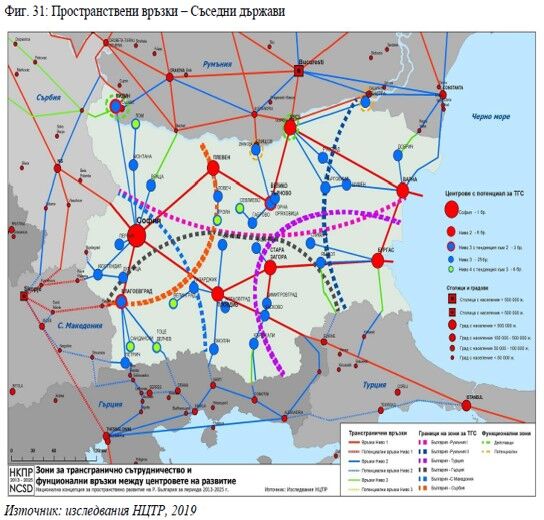
- Improving the condition of specific territories with unfavorable socio-economic characteristics - through packages of measures with a social orientation, cooperation and cooperation within the scope of agglomeration areas, development of cross-border functional areas;
- Development of targeted growth zones, balancing the polycentric model of the national space through state aid, encouraging investment, innovation and modernization;
- Disaster risk reduction through integrated preventive measures in natural and urban environments.
The advantages of the national space in 2021-2027 are:
Rich nature – diverse relief and landscapes, favorable climate, attractive natural complexes (water, rocks, forest), numerous deposits of mineral waters with different characteristics and significant flow rate, habitats with rich biological diversity;
Evenly distributed network of settlements - well built of settlements of different rank; - well built of settlements of different rank;
Territories with a unique character and untapped potential for tourism development - they are located almost everywhere, combine natural and cultural values, offer a recreational environment with attractive accessibility, bioclimatic comfort, communication connectivity and a balanced human presence;
Organic agriculture - presence of many microdistricts with favorable conditions and untapped potential for organic agriculture - clean and fertile soils, suitable climatic conditions, sufficient water resources;
Political and social stability - relatively stable, supported by ethnic tolerance and united by constructive interactions in areas with mixed populations.
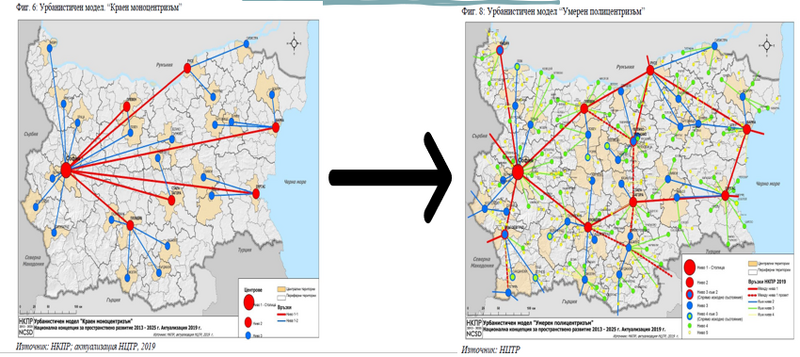
The current state of concentration nationally in the period 2012-2020 it was an urban model of the "Extreme Monocentrism" type, which had to be transformed to an urban model of the "Moderate Polycentrism" type. And during the period 2021-2027, an irreversible movement towards a more balanced model is expected.
Challenges in national/regional planning until 2030 are:
1. Infrastructural deficits - delay in the optimal connection of the national territory with the neighboring countries and the main directions to Europe and Asia, delay in the construction of the elements of the TEN-T network in the national territory, delay in the optimal transport connection between the weak Northern Bulgaria and the stronger Southern Bulgaria;
2. Tendency towards monocentrism - continued increase in the population of the capital - the city of Sofia, which threatens the polycentric development in the country and the balanced development of the neighboring municipalities;
3. Demographic stagnation and depopulation of peripheral territories;
4. Excessive exploitation of tourist resources - reconstruction of the most attractive territories along the coast and in the mountains around the formed resort-tourist agglomerations, leading to the destruction of valuable landscapes, overloading of the transport and technical infrastructure, deterioration of the quality of the environment and of the offered tourist services;
5. Extensive and chaotic urbanization - "green" construction, neglected needs for reconstruction, renewal and revitalization of many urbanized environments, lagging construction of the networks and objects of the engineering and technical infrastructure in the areas of new construction - endangered ecological balance and compromised standard of the anthropogenic environment;
6. Unexploited cultural heritage - underestimation of the role of cultural heritage as a factor for economic growth, for generating activity and attracting interest and investments, weak coordination and concentration of projects related to the disclosure, exposure, socialization and valorization of the country's cultural values, especially those of global and pan-European significance.
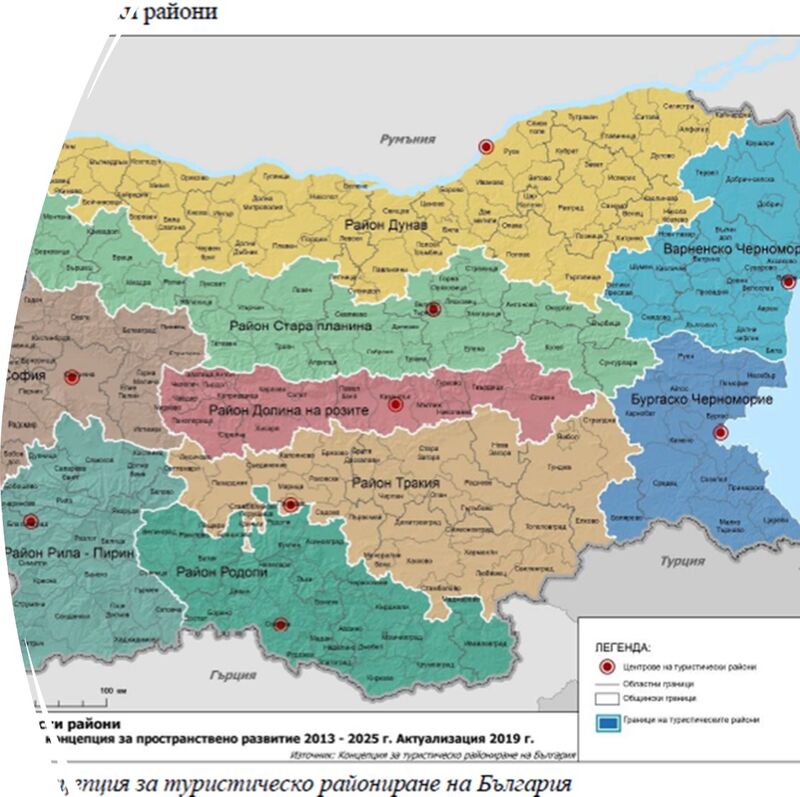
Tourist zoning and planning in Bulgaria in 2021-2027:
• Improving the types of tourism and cultural synergy through sustainable development of Bulgaria's historical and natural resources.
• Adaptation of everyday life and economic sectors in Bulgaria to the conditions of pandemic and restrictions through sustainable management of national resources for tourism in nature - high-altitude air and mineral water.